Huliau - The Return Voyage

A Native Hawaiian Spiritual Retreat

Geography: Faces and Temperments.

It is impossible to travel as ‘Iokepa Hanalei ‘Imaikalani and I do–from Portland, Oregon to Portland, Maine–from Washington State to Washington, D.C.–and not notice the differences.

I am not speaking about mountains, oceans, rivers, lakes, prairies and deserts.  It’s the human differences:  The face of a place.

I’m speaking of the angles and planes of the human face–and I am speaking of the human temperament of a place.  They are very different.

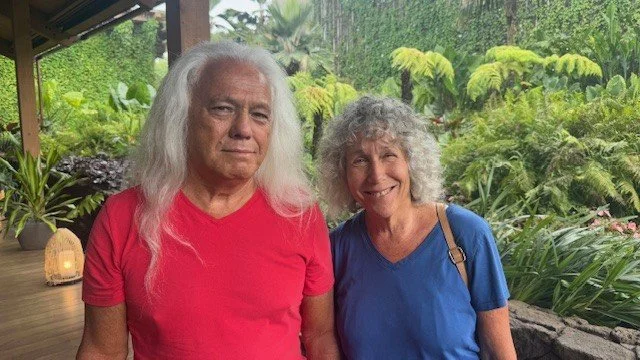
We are at this moment among the cool, reserved New England faces.  They are lovely and angular; they are comforting to me.   The cerebral greets me well.  These people do not  often wave from  car windows at strangers walking along the lanes.  They don’t speak randomly to one another in urban elevators.  They seem, to both this Hawaiian man and his Jewish wife, contained.

These are not people who are in your face, invading your privacy, or emoting publicly.  I speak this with absolutely no judgment.    The spaces are soothing for me; for ‘Iokepa, I suspect, it is a bit perplexing.

We came here almost directly from Southwest Virginia, where it is virtually impossible to pass a stranger on the street without a conversation that exceeds-by-far a simple greeting:  ‘Iokepa’s comfort zone.  Where the assumption is that humans welcome warmth and the exchange of civility.  The faces are rounder there.

Now there really aren’t any over-arching ethnic reasons for the difference: a distinct  Scotch-Irish and English mix in both places.  The climates are different.  Here it is cold, indeed, most months of the year.  Caskets sit unburied until spring because the earth won’t accept them.  There, the growing season allows ample time for pumpkins and cantaloupe; the winters are short of adventure or excess.  But summer humidity and temperatures are over-the-top.

I realize that I’m describing stereotypical Yankee-Dixie differences.   We’ve traveled 60,000 car miles in these past three years.  We can speak with feeling about the faces in and of  Oregon or New Mexico, Louisiana or Minnesota.

‘Iokepa carries a billboard of the Hawaiian Islands on his face, in his body, and permeating his emotions.  He has  wide-spaced eyes in a full, but not fleshy face, cheekbones that cannot be ignored;  kanaka maoli splayed feet, enormous calves, and brown skin.

For all the enormous calf and shoulder muscle, these native Hawaiians are soft.  It is how they meet the world:  welcoming,  inclusive.   Only those who’ve been exposed to, and colored by,  the occupying peoples on their Island behave otherwise.

In truth, both ‘Iokepa and I savor the distinctions.   In more intimate and penetrating climes,  I’m in hiding and ‘Iokepa is well-met.   In more cerebral and reserved places, he is scratching his head and I’m happily doing what I do:  writing alone.

We treasure those differences.  We are excited by the adventure of the next unknown place and face.  That we share.  We share too an appreciation for  diversity of every stripe and wrinkle.   And we find ourselves - both of us - in confused opposition to the: ‘All is one’ and ‘All is good version of reality.

I think we’re closer to: ‘How boring is that?’ and Not all are equally good for me.’

We agree to celebrate the excitement of the unexpected other.  We’re forced every day to do that within our marriage.  And so far, it has worked out just fine.


  • Share/Bookmark
No comments

Mothers and Daughters, More or Less.

For the past two weeks I’ve been blaming the heat.   And yes, it’s been a record-setting  100 degrees  in inner-city Baltimore, with an unconscionable level of humidity.  But yesterday I realized that is not  it–not my problem at all.

Allow me to digress.

My oldest brother is a professional man.  He was the apple of my father’s eye.  My next brother, the self-proclaimed “middle child”, tried harder.  He took over the family business and cared for our aging father every day of his life.

I am the third child–the only daughter.  My father  cherished me without reserve throughout my  childhood–and worried about me every day thereafter.  He fretted over my every deviation from his feminine ideal and expectation.

When our father died after a brief illness, fourteen years ago, my brothers’ loss seemed inestimable.  I grieved then,  and I continue to cherish the memory of that honest and generous man.

But what I’ve been living in these past  weeks, during this hottest of Baltimore summers, is something else entirely. My feelings now are far more complex.

My mother.  Inch by gradual inch I am losing my  98 year old mother.   No, it has not been the heat that has drained me.  It has been the enervating emotion watching my  familiar mother become much less familiar.

I am a woman.  This is my mother.  I stand in front of  any mirror and I see her–in my hair, behind my smile.   Sometimes  it’s a  struggle to see where she ends and where I begin.

I have an iconic teenage memory.  We are locked in a Department Store dressing room staging warfare over some obscure matter of taste.  We  enlist the hired help (a saleswoman who foolishly dares to offer an opinion) to help defeat the other in a staged battle over hemline length, ruffles, glitz, color or neckline.  We define our relationship for many years by the clothes we refuse to wear–and those we do.

I have an iconic adult memory.  I had been  a vegetarian for nine years years.  My mother makes a thick chicken soup  for me when I arrive alone for dinner.  She insists, “But poultry is not meat.”  This is not an ignorant woman.

I remember, of course, my mother’s vehement objection to both men I married:  The first, because “He is not Jewish.”  The second because: “You hardly know him.”    I remember her caveat to my life as an author.  “The only women writers who succeed  have rich husbands who support them.”

I could go on.  I believe that almost every  women can–and does.  The songs we sing  with our mothers are seldom two-part harmony.

Regardless of the stories, the complaints,  the engaging and the disengaging–regardless of the complexities of being the strong daughter of a strong mother–this is the parent who knew me then, who knows me now.  This is the person who loved every bit of me (however much she objected).  This is the woman who ultimately accepted (and found reason for pride) in my every choice–no matter how far I wandered, or how incomprehensible those choices were to her narrower life experience.

Today–I enter her apartment at the senior community (where she moved two years ago, when we agreed that 96 might be a good age to stop driving)–and her eyes laugh and dance.  She tells me:  “You have no idea how much I love having you here!  You have no idea how much I love you.”  Her whole body speaks that truth.

I am losing her.  Not like my father after a three month critical illness.   My mother lives and breaths and walks (every day more slowly and with increasing fatigue).  She remember selectively, and surprisingly.   She forgets what she had for dinner, or whether she even had it.  She no longer has a ‘yesterday’ or even a ‘this morning.’   Time has disappeared. My mother teaches me  still. She instructs me in the absolute value of  this breathe, this moment–gone!

This is a woman who has  lived life with enthusiasm and zest  from the moment she took it on.   ‘Mollie with the million dollar smile’ accepts life.  She has systematically accepted difficult women among her many friends.  She explained them like this.  ‘That’s just how she is.’

She accepts too the losses.    What has been acutely painful for me to witness–has been far less terrible for my mother to live.

Return Voyage alights here for  three hot summer weeks.   ‘Iokepa and I house-sit our son’s cats and plants, in a downtown Baltimore neighborhood.  Our son and his wife vacation in Cape Town, South Africa, at the World Cup.   We’re here for my mother.

Mollie Speert Miller may live to be 105–only God has that answer.  Her health is perfect.  But her body, her 98 year old body–skin, bones, and brain–is simply wearing thin.   I watch my mother and I am helpless with grief.  What she accepts, I  continue to deny.

Mothers and daughters–there isn’t a more fraught and complicated  relationship.    I cannot imagine a life without it.


  • Share/Bookmark
5 comments

Loyalties.

Each of us cherish certain values above all others.  Honesty?  Courage?  Common Sense?  Responsibility?  Generosity?  What have I missed?  The order may fluctuate with the day.  We  gravitate to people who  share our values.  Political.  Occupational.  Spiritual.  Ethnic.  Intellectual. What have I missed?

At the top of my personal priority list has always been, “Loyalty.”   A few memorable times in my life, my heart has been broken by a friend who lacked the guts (at no particular personal cost, that I could discern) to stand up for me, when their voice would have made a tremendous difference to outcome.  Instead, they hid out, voiceless.   I considered the act a dereliction of friendship–and disloyal.

Understand that I count myself a loyal friend.  And yet, I am about to offer the heretical:  Perhaps the hardest thing to do in this world, is not (as we might assume) to stand up for a dear friend (that  seems  obvious, practical,  and relatively self-serving), but to stand up to a dear friend.   To say, “No” when “Yes” would be infinitely easier; to refuse when we just want to get on with it.

With tongue firmly in cheek, I suggest some familiar  circumstances:  “Does this dress look good on me?”  “Do you think I should marry her?”

What I am proposing here is the possibility that there may be a higher loyalty than that we owe our best and our dearest.  And that loyalty is to our own vision, our own knowing, our deepest truth.   I am saying: When our loyalty to friendship is at odds with our inner certainty, we are obligated to follow our own.

‘Iokepa and I seemed to have  hit a few, simultaneous, interpersonal, obstacle courses during the past week.  We’ve been forced to consider this matter.

First.

A dear friend, a writer, agreed to read my book and critique it.  Hers is a noble and generous under-taking in the life of  a very busy woman.  I am grateful.  But before she could even turn the first page, she had a dream. Her dream’s editor demanded an entirely different beginning–a good one, with great purpose.  My friend told me the dream, and made a strong case for it.

‘Iokepa Hanalei ‘Imaikalani and I are great believers in dreams.  He is from a people who say that when we dream without fear:  “The past, present and future open to us.”   So, first of all, there was the remarkable explicitness of the dream.  How could it not be significant?  And second, there was my generous friend.  How could I oppose her, when she was gifting me her love and time?

The problem was this.  The dream editor’s first chapter (though crafty and attention getting) was not at all congruent with my vision for a book I’d considered now for ten years.   I absolutely welcome critique, and potential change–and  I feared that I would sound defensive opposing the dream editor.   I worried, too, that I’d offend a woman who was giving so much, so selflessly–with no return for herself.   I feared, finally, that I had lost my fresh-eyed reader to the dream’s determination.

I wanted to say absolutely nothing.

Finally, however, I found the words–blessedly clear words–to say what I needed to say.  She heard them.  She apologized profusely for what needed no apology.  In sum, she completely understood.  She is my old and dear friend.  She knows me.  She didn’t need to be told:  That  I am very open to critique and change; that I value dreams; that I am grateful for her gift; that I could not agree to the dream’s edit.

In this same week:

Two valued friends competed for the use of our eleven year old Subaru (sitting, in our absence, on Kaua’i).  The first asked us a month ago if  his visiting son could use it.  We agreed.  He’d been using it since then; he planned to use it for another two weeks.

The second friend had an unforeseen need, and assumed that it would be available.  When it was not forthcoming–this friend, magnanimously allowed that she would manage without it.  She did not want to create any hard-feelings between friend number one, and us.  She relinquished her claim.

Remember, this was happening at a six-thousand mile distance.  We are on the Mid-Atlantic coast of the Eastern Seaboard of the United States–skimming across Maryland, Virginia, and North Carolina.  For me, at this distance, it would have been easier to let sleeping dogs lie–to do nothing, to say nothing.

But ‘Iokepa saw it differently. He followed his own moral compass, and I had to agree.  There were other cars the son could use.  The second friend (who housed our car in her driveway, in our absence) had no other.  ‘Iokepa helped me craft the loving and assertive email  insisting on the switch–immediately.  Again, it was accomplished with grace and ease.

Loyalty–if it is not to that which I hold dear, than it certainly is not to those whom I do.


  • Share/Bookmark
4 comments

Evangelism?

In the past four weeks, we’ve crossed the continent (covering 3,500 miles) in our black Camry.

On that crossing:  We had dinner with a saintly, eighty-four year old, Jesuit priest in Portland, Oregon; we had high tea with a Japanese Buddhist.  We stayed in the home of the eldest of eight siblings in a Mormon family, that traces its roots to the earliest in Salt Lake City.  In  Missouri, we broke bread and bared souls with a Unity minister–a woman whose heart and mind are as open as the roads we traversed across Nebraska.

In Louisville, Kentucky–we stayed in the home of the man who blew the conch shell that summoned guests to ‘Iokepa and my Hawaiian wedding, many years ago.  In Charleston, West Virginia, we had deep and meaningful conversation with Southern Baptists of the mega-church variety.

Now, we are in Baltimore with my Jewish family for Mother’s Day.

Religion makes a difference; culture makes a difference–and well it should.  ‘Iokepa Hanalei ‘Imaikalani would be the last to say otherwise.   Return Voyage is about embracing and celebrating those differences.

Return Voyage is not–and never will be–evangelical.  We convert no one. We assume:  Each of us were born with our own answers, and that those answers require no more than awakening–not obliterating, under somebody else’s certainties.

Some people encounter ‘Iokepa and Return Voyage with fear, and with suspicion:  “What is this Native Hawaiian culture?”  is the question spoken aloud, asserting doubt.  The unspoken question is:  “Does it threaten mine?”

The authentic Native Hawaiian culture threatens no one.  Return Voyage doesn’t impose, doesn’t extract; does not have your answers.  ‘Iokepa has said:  “You don’t have to give up anything.  This is about making you more of who you already are.”

The Native Hawaiian people have always been (perhaps, to the detriment of their own culture) about:  Acceptance, inclusion.  They were free of any and all  judgment; they rejected war, hierarchy, sexism, racism.  You get the picture.  The Return Voyage is the reflection of that culture.

Fear–and it’s reactive judgment of the other–was the infection that that had to be injected by the very folks to whom ‘Iokepa’s ancestors opened their hands and hearts.

It would have been nice if when those first  missionaries arrived in the 1820s; when the first capitalists came a generation later; and when the New Age gurus arrived more recently, they had accorded the Native Hawaiians the same privilege.

Respect does not seem to be too stringent a requirement.

  • Share/Bookmark
3 comments

Stealing From The Native Hawaiians Again. (The Akaka Bill In Congress.)

The Bill

At the end of almost every Return Voyage gathering for the past three years, well-intentioned folks have asked ‘Iokepa:  “What can I do to help?”

He answers:  “When you hear that things are changing on the Hawaiian Islands–and you will–I ask that you offer a prayer for the Hawaiian people.”

There is pending now, before the United States Congress, a legislative bill, officially named, “The Native Hawaiian Government Reorganization Act of 2009″–more commonly referred to as, the “Akaka Bill.”

Return Voyage supporters across the United States have  written us:  “Finally, the Native Hawaiians will be recognized as the unique people they are–the theft of your land will be made right.”

To our many friends, allow me to clear the political fog.  The Akaka Bill–which has been bouncing around Congress since 2000, and which passed the House of Representatives a number of times, but repeatedly died on the floor of the Senate–is absolutely not the change ‘Iokepa Hanalei ‘Imaikalani had in mind.

Instead of freeing his sorely oppressed Native Hawaiians, this Akaka Bill slams the final nail into the coffin that has incarcerated the Kanaka Maoli (original people) since the arrival of the first Calvinist missionaries.  (For more, go to  www.ReturnVoyage.com and click on the Historical Timeline.)

The intention of the Akaka Bill is to silence ‘Iokepa and his brethren.  The bill essentially says:  We (the government that was imposed at gunpoint) tell you (the native people who’ve inhabited these islands for 13,000 years) what you deserve.  This Congressional bill codifies the existing reality:  You accept what we offer, and you shut up.

The Background

Under this bill:  All authority remains with the original colonizers, who were, when they arrived, the Calvinist missionaries, then their sugar cane baron sons,  and then (when sugar cane ceased being profitable), they became, and remain, the real estate developing grandchildren.  Under the Akaka Bill, the transfer of  ‘Iokepa’s nation into the hands of the U.S. Interior Department insures their continuing privilege.  Those in power–either corporate or governmental–retain power.  Those disempowered (the impoverished Native Hawaiians) remain powerless.

These aboriginal people, who have for 13,000 years welcomed guests to their Islands with open arms, open hands and open hearts, are asked now to relinquish their claim to freedom.  Under the Akaka bill, they consent to become another, “Indian Tribe” minus, “Tribal” rights to pursue land claims in the courts.  It essentially legitimizes the land theft.

Still today, the grandsons and great granddaughters of the two-dozen families who overthrew the Hawaiian nation  proudly and publicly hang this framed photograph:  Their sugar cane baron ancestors holding  guns to the head of the last remaining Hawaiian monarch.

Queen Liliokalani, gun to her head, bravely held fast to her cultural values.  In her final aloha, she refused to shed her people’s blood; she was imprisoned by the men who claimed her land.  The U.S. Congress rubber-stamped the take-over of this sovereign nation.

The perpetrators made their fortunes; desecrated the land that fed a native people; outlawed Hawaiian spiritual practices.

In 1993 (on the 100th anniversary of the take-over), President Bill Clinton signed a Congressional “Apology Resolution” acknowledging the facts I’ve described, and supporting the Native claim.  At the conclusion of the signing, Senator Slade Gorton (R-Washington), said in the Congressional Record:

“…the logical consequence of this resolution would be independence.”

‘Iokepa’s people have profound spiritual gifts that can and will  inform the earth’s behavior. They are in no way, or manner, political–and that fact has been used as a knife against them. It has been in the political arena, for almost 200 years now, that the gentle, loving, beautiful Native Hawaiian people have been  disenfranchised in the name of greed.

The Confusion

The Akaka Bill is not what ‘Iokepa or his people choose.

Native Hawaiian, anthropologist J. Kehaulani Kauanui wrote in her recent book,  Hawaiian Blood.

“But the paradox for the Kanaka Maoli is that the state of Hawai’i, and arguably the U.S. government, has its own investment in seeing this political goal (the Akaka Bill) obtained because it would limit Hawaiians’ full sovereignty claim and extinguish land title–namely the kingdom, crown, and government lands–and thus settle the state’s ongoing  ‘Hawaiian problem.’

“So…the federally driven legislation threatens to amount to yet another land grab in the guise of ‘Protecting Hawaiians’.”

Politics makes strange bedfellows.  It is sometimes hard to tell your friends from your foes.

Passage of the Akaka Bill by the U.S. Senate, to date, has been withheld not by the Native Hawaiians themselves–who remain, as usual, rather powerless in this political conversation.  It has been killed by the far-right.  It has been killed by U.S. Senators who argue, ironically, that any acknowledgment of a native claim to their culturally unique identity is, “Racism.”  In other words, the very people who brought the concept of, “Racism” to this isolated Island chain (where Native Hawaiians accepted all souls without judgment), are the ones who now accuse the Native people of being, “Racist” for claiming their cultural inheritance.

And the confusion get thicker.  The Office of Hawaiian Affairs, which is a state government agency that has been assigned (by the governmental and corporate powers-that-be) the role of,  “Speaking for the Native Hawaiians” has spent millions lobbying on behalf of passage of the Akaka Bill–which would guarantee these political office-holders continued political influence.

No wonder our good friends are confused.  No wonder the media is confused.  No wonder President Barack Obama is confused.  Each absolutely believe that this legislation might bring some healing to an indigenous people who die younger, live sicker, and are most likely to be homeless, impoverished,  incarcerated.  These are all well-meaning allies of  my husband’s people who have been victimized (and baffled) by the millions spent to pass this bill–the public relations blitz, the rhetoric of fear.  (”Without Akaka, you will lose what little you have.”)

In sum:  The Native Hawaiian Government Reorganization Act of 2009 is a case of false advertising.  It is not the ticket for good–unless by that, we mean:  “The missionaries came to do good, and they did well instead.”

I ask our friends to please share this essay–and your endorsement of it–with your Senator, Congressperson, newspaper–anyone who might make a difference.  The Native Hawaiian people deserve to decide their own future.  And that can’t happen within the U.S. Department of Interior.  The Native Hawaiians are not a tribe.  They are a nation–and their nation is occupied.

  • Share/Bookmark
4 comments

Justice Served: Court Ordered Community Service.

This is the story of trust, faith, and the powerful support that accrues when we agree to use our unique gifts, our best natures, and take the path of  greatest good–to fulfill our life’s purpose. Every one of us has one.   Our task, really, is to find it–and then, fearlessly, to live it.

For thirteen years now, ‘Iokepa Hanalei ‘Imaikalani has actively reclaimed his aboriginal Hawaiian history, language and culture.  He has (at his ancestors’ insistence) carried not a scrap of paper that might confuse his native identity with an American one.  That has meant, of course, he carries no American driver’s license, uses no social security number.

‘Iokepa’s argument has been consistent:  “I’m not an American;  I am a Hawaiian, in my culture, with my people, on my Island.”

For the “Crime” of being an unlicensed Native Hawaiian, he was summoned recently to a U.S. District Court, and put on trial.  In court, defending himself without attorney, ‘Iokepa told the judge: “There is law, and there is justice.  I am asking for justice.” (You may read the entire back story on this page:  “Inside a U.S. Courtroom:  A Native Hawaiian Speaks,” February 13, 2010.)

The overwhelming consensus of the emails, phone calls, and comments to this site can best be summed:  “Justice was served.”  The act of justice being served meant to many that everyone looked good:  ‘Iokepa and his people appeared honest, altruistic, and principled.  The U.S. Court system, like Solomon, seemed flexible and wise.

‘Iokepa and the judge agreed to twenty-one hours of required  “Community Service.”

‘Iokepa told the judge:  “My wife and I have done thirteen years of community service.  I’ve never taken a paycheck.  That is the culture I represent, taking responsibility for all people in all circumstances.  This is our walk of faith.  And, that will continue whatever happens here today.”

Within those 21 hours of court-mandated “Community Service” ‘Iokepa felt the hand of his Grandmothers on his shoulder.  He saw this as an, “Opportunity” and he was, “Excited where it might take me.”

This is the story of where it took him.

Several days after his court appearance,  ‘Iokepa was required to report to the man who administers the Community Service arm of the court system.

All U.S. government offices are located in the center of our 70 mile long Island; our post office box is just a few blocks away.  They are each an hour’s drive from the far-northern edge of the Island, where we have lived these past few months.

Together, ‘Iokepa and I drove that hour to the Community Service appointment.  It made sense to stop at the Post Office first and check our mail.  One letter fell from the P.O. Box  into ‘Iokepa’s hand.  It had a return address that neither of us recognized.

It turned out to be a note from a stranger who had read ‘Iokepa’s newspaper interview two months before.  She’d been moved (during these intervening months) to send us her kind words, a $33 donation–and her business card.  The card described her as a minister,  the “Spiritual and Bereavement Care Coordinator” at the Kaua’i Hospice.  On the back of the card, she wrote, “If Hospice can be of help in any way…”

We went to the scheduled, “fifteen minute” appointment;  it lasted an hour and a half.  ‘Iokepa’s work has always followed him where ever he walked, or where ever he stood.  And here, behind this desk, sat a bright, respectful young man, in a unique position to affect so many of the very disaffected men and women on this Island.

Tyrus was exactly the sort of young man who habitually and deeply connects with  ‘Iokepa’s cultural message.  It would be presumptive of me to wonder which of ‘Iokepa’s words were most compelling to Tyrus–or whether their shared athletic past (Tyrus, college baseball; ‘Iokepa, football and competitive martial arts) was the glue.   But I sat, as I do on these occasions, in awe of the apparent bonding.

Clearly, ‘Iokepa was not the usual drunk driver,  drug dealer, or domestic abuse perpetrator to cross Tyrus’ desk.  Certainly, Tyrus had heard all the lies–and the man sitting across the desk from him now was not there to deceive to him.

But there remained the matter of community service.  “Usually,” Tyrus said, “The court wants us to assign some kind of physical service–to make people work their sentence off.  Obviously that’s not appropriate here.  What would you like to do?”

‘Iokepa sat silently, waiting  as he does for word from the Grandmothers.  Tyrus ran through some possibilities:  Teach children in a school, work with them in a community center.

‘Iokepa was unmoved.  And then, he looked down at the envelope in his hand.  “What about Hospice?’

Well, the office had never sent anyone to Hospice before, but Tyrus jumped on it.  It could be done.

And so, days later, when ‘Iokepa phoned the woman who’d dropped us the note, she was beside herself with excitement–and she flew into high gear.  In the end it was decided:  He would offer a Return Voyage training in Hawaiian culture and spirituality to the Hospice professional staff.  On later dates:  ‘Iokepa would be slotted into already existing panels and seminars on:  Cultural Differences Around Death and Dying.

I’ve never seen ‘Iokepa more certain that he was following the Grandmothers’ plan (or more motivated to carry it out) than he was in those weeks before his Hospice service.  Their “Plan” began for ‘Iokepa the day before he was ticketed, with his prayer to, “Move my work forward.”  It pursued him:  Through his trial, toward the note from the good Reverend, to  his appointment with bright-eyed Tyrus–and finally to this Community Service with Kaua’i Hospice.

The trial and its results came exactly one year after ‘Iokepa’s much-loved mother died.  He knew, this was a way to honor her.  But he also knew that Hospice had  been unable to, “Get a Native Hawaiian to speak to us about the culture’s view of death and dying.”

That reticence, ‘Iokepa told me later, was in part:  “Shame…”  after 150 years  when Native Hawaiian culture was outlawed into oblivion by Calvinist missionaries.  And, in part, because:  “So many of us don’t know…” for exactly the same reason.

This past week, with the Hospice staff gathered to listen, ‘Iokepa was inspired–and persuasive.  He’d say afterward:  “I could hear the Grandmothers.”   But it was more.  These were a remarkable group of humans:  People whose lives are dedicated to caring for the incurable; for understanding that life doesn’t end at the seeming end–and, in any case, assuring that the last words from this side are compassionate ones.

‘Iokepa spoke for his aboriginal culture:  “There are two births.  The one from our mother’s womb into  human life, and the one from human life into our Creator’s arms.  There is no death, only birth.”

These special people draped a ginger lei around my neck, and a maile leaf lei around ‘Iokepa’s, by way of  appreciative greeting.  They hung onto his every word and seemed transported by his chants.   Through ‘Iokepa, his Native Hawaiians and their sublimely spirited culture were deeply honored in a place where it will absolutely make a difference.

  • Share/Bookmark
2 comments

Tsunami (Kai e’e) On The Shores of Hawai’i.

For every memorable year of my adult life, I have had one recurring nightmare.  In that dream, I am running for my life from a rapidly approaching, formidable wall of water that it is absolute certain, I cannot outrun.

For every memorable year of my adult life, in any of my many domestic and foreign homes, I have never lived anywhere near that possibility–never once lived on the edge of an ocean.  Until twelve years ago, when I met ‘Iokepa, and moved my life to these Hawaiian Islands.

I’ve never had that nightmare since.

This Saturday past, I was awakened at 6:00 a.m.–not by the ubiquitous roosters–but by an air raid siren.  (I was dreaming, it turns out at the time, of Bess Myerson, the first Jewish Miss America, chosen in 1945 at a time when her religion was a significant factor working against her selection. )

‘Iokepa awakened immediately to the sound of the sirens and said:  “Kai e’e!” which means, in Hawaiian, tidal wave.  When you live on speck of dirt in the middle of the vast Pacific Ocean, hurricanes and tidal waves are apparently part of your consciousness.  They are not nightmares, they are fact of life.

We turned on our cell phone, we turned on our computer.  Since three in the morning, our silenced phone messages had been screaming warnings from family on other Islands–various versions of, “Get to high ground!”   The computer shouted email alerts from friends across other time zones.  We have spent much  of our lives here living in tents on  Kaua’i beaches.  Friends and family feared for us.

But this time we were high and dry.  It was our turn to  call with proffered help, friends who’s homes were coastal–and in danger–people with farm animals in need of rescue, people in need of a place to escape.

And every hour from 6:00 a.m. until 11:00 a.m.–with a final blast at 11:15–the sirens screeched their message of doom.  Roads were closed; helicopters circled remote areas looking for folks without phones, computers or radios–there were plenty.

We gathered with our neighbors, and others, on the highest ocean lookout near our home.  It was hot and sunny, the ocean looked particularly flat and still.  People brought food and picnicked.  Hours passed, the threat passed.

So, I live for the first time in my life in a place where tidal waves pose potential disaster, and I no longer dream that nightmare.  Clearly, the terrifying wall of water that threatened me so that I could never ever outrun it, was something symbolically other–a metaphoric fear that no longer needs to awaken me.

I suppose that once I’d given up my glass house on that highest hill in Portland, my successful writing career, my family and my friends, to live in a tent on windblown tropical beaches…once I’d agree to enter the aboriginal nether land between the solidity of my five resolute senses and the fuzzier world of ancestral spirits…once I’d risked life, limb and sanity to leap full-steam ahead into this Native Hawaiian, “Walk of faith” with ‘Iokepa–once I’d agreed to all that, I’d already lived through the tidal wave.   Sorry, ‘Iokepa, I mean, through the kai e’e.

I’d already lived through the worst of it.

  • Share/Bookmark
No comments

Inside a United States Courthouse: A Native Hawaiian Speaks.

The Setting

The very first American Court House erected on the Island of Kaua’i was built with full awareness and intention on the top of the bulldozed ruins of what was the oldest hei’au on this Island.

Hei’au were (and those that remain, are) sacred stone enclosures for Native Hawaiian ritual and spiritual practice, prayer and cultural ceremony.  Every hei’au was built in alignment with the planets and the stars–with an ancient people’s sophisticated awareness of the night sky.  Each hei’au sat within full view of the ocean horizon.

These sacred stone walls, built without mortar,  and standing tough for thousands of years were deliberately destroyed to make way for  an American claim on another nation–Hawai’i.

That oldest of hei’au is where the first Calvinist missionaries and their offspring planted their first American Court House:  Where they enforced laws that denied Native Hawaiians the right to speak their native language, the right to name their children a Hawaiian first name, their right to use herbs and plants for healing, their right to any cultural practice attached to their way of life, Huna–for 150 years.

Since 1972, Native Hawaiians may legally speak and name, plant and heal, dance and pray.  They may do these things–but they no longer can.  Cannot, because of  colonial dishonoring and outright destruction of  hei’au,  fishing beds, forests–land and ocean.  And , of course, because of a 150 year gap in genealogically transmitted knowledge.

The imposed government outgrew their first Court House many times over.  And in August, 2005, the county of Kaua’i dedicated a new and extravagant $42 million “Judiciary Complex,” housing the United States court rooms.

When we arrive, now, by airplane to this tropical Island, and we leave the lovely, open-air, welcoming airport–we encounter first, this bulwark of the American judicial system.  Before we see the ubiquitous ocean, mountains, or banana trees, we see this way-out-of-scale “Judiciary Complex.”

‘Iokepa Hanalei ‘Imaikalani said succinctly of the huge investment of much-needed  public money:  “For some people, this building is reassuring–it makes them feel safe.   And for others, it is the death of a culture.”

Thursday, February 10, 2010. 10:00 a.m

It was to this building that ‘Iokepa drove our 1998 Subaru from the Northwest edge of the Island to its center–an hour drive–with no drivers license. It was in the doorway of this building that ‘Iokepa and I passed through security gates,  temporarily relinquishing my purse and his belt, and made our way to the District Court for  ‘Iokepa’s trial.

Thirteen years ago, on the heels of an incredible spiritual epiphany, ‘Iokepa was reminded: The time had come to fulfill his promises.  Promises made, outside of memory, when he took on life–and, perhaps, before that.  ‘Iokepa’s ancestors reminded this successful businessman that it was time to return home.  That he must surrender every scrap and morsel he’d worked for all his life–and embrace instead the original culture of his ancestors.

In two weeks, he relinquished that house on the lake, seven cars and a hot rod and $1,620,000.   He arrived at the airport and deposited the last of it:  His social security card, drivers license, and every single bit of identification that tied this aboriginal to an identity other than Native Hawaiian.

For thirteen years, he has flown on airplanes, and driven the streets of  Hawai’i and America with a flimsy, laminated, computer generated picture ID that connects him only to a specific Kaua’i hei’au that he maintains.  This particular hei’au marks the true-North for the Island.

Last November, while driving to the post office, ‘Iokepa was stopped by an police officer.  He was driving a car, he did not own, with an expired registration.  He was ticketed:  For that–and for having no  motor vehicle license.   Read the back story, on this page:  “Part I:  Free My Husbands Nation…” (November 26, 2009);  “Part II:  Free My Husband’s Nation…” (December 12, 2009); “Part III:  Much Ado About Automobiles…” (December 30, 2009).

In December, he appeared before a District Court hearing, and requested a trial.

Today was that trial.  ‘Iokepa’s argument has been consistent:  “I’m not an American;  I am a Hawaiian, in my culture, with my people, on my Island.” That is precisely what he told the judge.  Consistently, he has said:  “There is law, and there is justice.  I am asking for justice.”

Oh there were warnings aplenty, from sidewalk lawyers and real ones.  His, was an argument, they said, that, “Could not be made in an American courtroom. There could be no precedent.”

But it was an argument that innumerable friends and supporters prayed would be heard.  Dozens of phone messages filled our usually quiet cell phone in the 24 hours before the trial.  Dozens of emails filled the Return Voyage box.  They sounded much the same:  “Tell me the hour of the trial–I will be with you.”  Truly we felt that safety net of affection and faith.

For his “Crime,” ‘Iokepa faced:  Thirty days in jail, several thousand dollars in fines, and abundant court fees.

There were seven trials on the court docket this day.  Everyone–except ‘Iokepa–was represented by an attorney.  ‘Iokepa’s case was called fourth.  He followed a child mauled by a dog, and a kid who skipped out on his first court date.  I don’t remember the third.

‘Iokepa said afterward, that when his name was called:  “I felt shot out of a rocket…the adrenaline.  It was like the song you’ve never sung before, but you know the words.”

He looked it and he sounded it.

When the judge asked if he wanted to hear the maximum punishment, he answered “I’d rather hear the minimum.”  When ‘Iokepa spoke of the thirteen years of unpaid community service that he and I have lived here, and the judge said, “Yes I believe that its everybody’s duty.  I walk the beaches and pick up trash.”

‘Iokepa answered:  “That’s a good thing.  But when I speak of the community service, it is this.  My wife and I lived in tents in the public parks for ten years among the alcoholics and drug dealers, the spousal and child abuse–the results of oppression.  We did not get out of the tent and lecture people–we live so as to offer an alternative.  I don’t smoke.  I don’t drink, and I don’t use profane language.

“I have stood in the middle of two men about to fight, and I have insistently reminded them that this is not how their ancestors would have handled it.  And you know, these men no longer fight, no longer drink.

“We’ve done thirteen years of community service.  I’ve never taken a paycheck.  That is the culture I represent, taking responsibility for all people in all circumstances.  This is our walk of faith.  And, that will continue whatever happens here today.”

‘Iokepa told the judge, “I didn’t walk in  here alone.  My ancestors are here, and your ancestors are here.”

‘Iokepa did not dwell on the Hawaiians as victims of oppression. He spoke personally because, it seems, the personal touches hearts–the political closes them.  The Hawaiian culture–that which they have to teach the rest of us–is purely spiritual.

Later, ‘Iokepa told me:  “I  felt like I was holding the floor and that everything was mine.  I felt that the building needed something from the ancestors.”

He spoke his last words to the prosecuting attorney during their mandated conference:  “I know that you’ll do the right thing.”

It’s a funny thing about those words that I’ve heard ‘Iokepa speak before–even to a K-Mart manager about a defective, past-warranty beach chair.  He says:  “They make a person responsible.”

From those words spoken in a doorway, to the table 25 feet away, the Prosecuting Attorney, with shaking voice, recommended that the judge drop all charges other than the absent driver’s license–and  for that offense, he asked 21 hours of community service, plus court fees.

The judge grinned.  When ‘Iokepa said:  “I don’t think that I can do better,” the judge prodded ‘Iokepa to continue the trial, “Because the prosecutor might miss something, and I can dismiss this case.”

In sum, this courtroom was full of folks whom ‘Iokepa had won over.  He had touched each of them with his transparent sincerity, passion, and adherence to his aboriginal culture.  But ‘Iokepa saw it differently:  “It was the Grandmothers.”

In the end, the judge (Who looked a great deal like the new U.S. Supreme Court Justice Sonia Sotomayor) said:  “Thank you.  I wish there were more people who felt like you.   I appreciate your statement.  I apologize…I don’t have a way…”

And in the end, when the clerk reminded her that the mandated minimum $77 court fees could be reduced in this case for some legal reason.  The judge laughed, looked at ‘Iokepa and said:  “We just saved you $40–the court fees will be $37.”  And ‘Iokepa answered:  “Give that to me in cash, and we can all go to lunch.”

Not one soul in that courtroom suggested or implied that he should get a license…that he should discontinue driving until he had one.  Not one, not once.

Afterward

Afterward, a dear friend who warned us of the impossibility of  ‘Iokepa entering the lion’s den and exiting unscathed, expressed his awe:  “You entered their turf–a U.S. courtroom–on your terms.”

My husband and I sometimes disagree–vigorously.  For the past three months, I awaited with anxiety the results of this trial:  None of which I could foresee would be to our advantage.  My anxiety deeply annoyed and distracted my husband, whose faith in the protection of his ancestors is bullet-proof.  One week before the trial, I surrendered that anxiety, and agreed that, whatever the outcome, it would be purposeful.  It would raise the consciousness about these people and their devastated homeland.

After a full three months of  anticipation, I am struggling to let Thursday’s events sink in.  Hence, my delay in writing this–and my uncertainty, still, about which are the essential words among so many, to be reported here.

‘Iokepa, on the other hand, is nothing but excited to be used, as the court intimated, in those 21 hours–speaking,  to and for those most in need of his words.

In truth, for both ‘Iokepa, and for me, this small victory for human decency is just that–small.  The morning after, he awakened and reminded me,  “We have a prophecy to fulfill, and it speaks to freedom–and responsibility–for all people.”

I could say more, but I won’t.


  • Share/Bookmark
12 comments

Life or Death?

Very soon, ‘Iokepa and I will both be able to enter movie theaters at a discounted rate.  And then too, at the family-owned grocery on Kaua’i called “Big Save,” we will be qualified to save still another five percent on Senior Mondays.

Can it be forty years since I traveled throughout Europe on an International Student Identification Card that guaranteed me lowered rates of entry to museums, rail travel, and more?  All that was required then to earn the discounted entrance fee was  enrollment in an institution of higher learning.

That felt considerably easier to me than what is required now.  Now, I must confess to being sixty years old–sometimes, tortuously,  to sixty-two.  Like uncounted others,  I weigh whether the admission of age is worth the $2 savings.

I notice that absolutely no one “Cards” me as they did back when.  I offered my proof to a ticket seller at a local cinema and she waved it away.  She rightfully conjectured “No one lies to make themselves older.” (At least, at this end of the continuum.)

I remember that my parents began reading the obituaries in their fifties–expectantly.  My mother still thrives at 98; my father saw his 91st birthday. But the odds have shifted.  When someone we know dies in their sixties, the world does not mourn that, “She died so young.” (Only those of us clustered near her age console ourselves in that way.)

Here’s the truth of these past few months:  One very good girlfriend is enduring chemo for advanced uterine cancer;  another just had a tumor lifted off her brain; another struggles through a recurrence of breast cancer.

Oh, how we rationalize to cover the fear.  “How can I have cancer!?!” the first among these pouted.  “I eat organic and I do yoga.”

And so, we hear the still healthy around these suffering women trembling and trying to nail down blame–to explain.  “Well, she’s too intellectual–not in touch with her real feelings.”  Or, “She shouldn’t have used estrogen supplements.”  Or, “She has a family history of…”  We say and do anything and all things to distance ourselves from the possibility of death.

We refuse red meat.  We swallow fist-fulls of  vitamins.  We reject caffeine, alcohol, milk, wheat, acidic and/or alkaline vegetables.   We walk, jog, stair-step.  We run our hearts out to distance ourselves from our friends who seem to be losing the race.  We make them the, “Other” with our carefully reasoned words.  And still, we die.

And still, we die.

And yet, this story is not, for one single moment, about death.  Quite the contrary.  But here is the link:  We are born, we live, we die.  Those are the inescapable, non-negotiable givens.  It never has been, “Life or death.”  It has always and forever been, “Life and death.

Yet too many times–too much of the time–we never live at all.  Afraid of death, we refuse to engage life.  Our lives are circumscribed by negation:  I don’t  risk hurt, eat pork, take chances that may harm my health, wealth or general well-being.  Steve Jobs, the founder of Apple computers advised the Stanford University graduating class, a few years ago:  “Stay hungry; stay foolish.”

Stephen Levine said it a long time ago in his book: Who Dies? which I always thought should be titled Who Lives? That while our lives are defined by the insurmountable fear of dying, we refuse to take risks, we refuse to follow our hearts, we refuse…to live.

‘Iokepa Hanalei ‘Imaikalani has often said of admirable friends or acquaintances who die at an advanced age:  “He died too soon.”  For these celebrated lives–engaged, conscious and fearless–he is absolutely right.  For the rest of us, I’m not so sure.


  • Share/Bookmark
No comments

Read This Book.

Very few days pass, when ‘Iokepa and I are not asked to recommend books about Native Hawaiian history, spirituality, or culture.

‘Iokepa always answers:  “Inette has written the book, Grandmothers Whisper.  It’s circulating to publishers now.”  My husband refuses to see that as self-serving because, “It’s her memoir, not mine.”  Nevertheless…

When he and I get down to the brass tacks of recommending a written path into authentic Hawaiian history, it is not easy.  To date there have been only three major books written by native historians that refute the skewed take of the missionary accounts–that European, Fun House looking-glass.

Now there is a fourth.  ‘Iokepa was the first in our local library system to read it.  We renewed it; I was the second.  It is powerfully well written, flawlessly researched, and totally original.

Hawaiian Blood by J. Kehaulani Kauanui, published by Duke University Press tells a heartbreaking story of the arrival of racism, greed and unbelievable cruelty to these Islands.  Who–you will ask when you read it–were the “barbarians” here?

Kauanui is an Associate Professor of Anthropology and American Studies at Wesleyan University.  We do not know this woman.  But we do know this work.  ‘Iokepa cried, and felt his stomach grip at what he has already lived and known. Now we can read it.

This book is more than history.  Kauanui steps up and describes the racism that defines, infects, and impedes the Kanaka Maoli (aboriginal Hawaiian) struggle for freedom– right now.


  • Share/Bookmark
No comments

Next Page »