Oh dear friends, you are owed an explanation. All of your very recent email-efforts sent to our website-linked: Inette@ReturnVoyage.com or Iokepa@ReturnVoyage.com have been bouncing back in your faces as “Undeliverable.” And, to our deep distress (and yours) that remains true.
‘Iokepa Hanalei ‘Imaikalani has spent the last 29 years of his life dedicated to nurturing and being nurtured by his Native Hawaiian people and their ancestral wisdom. When he speaks of the “culture,” he speaks of an authentic language, spiritual practice, and a kinship with every living thread of Creation - land and sea.
He speaks of a matriarchal culture that for thousands of years preceded the wars and hierarchy that arrived with colonization. He says that the original “kings” or “queens” were always the last to be fed – honored with a title for their utter selflessness.
It’s Been Awhile.
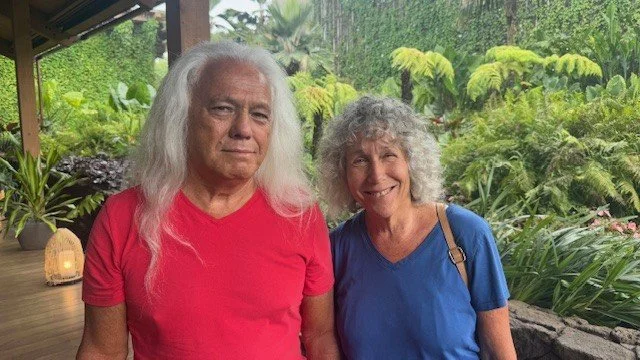
Though we try to keep our website text appropriately updated, we realized that we hadn’t added a new photo of the two of us in years. So, “No” to the critics; we’re not hiding our aging faces or bodies - we actually embrace those changes. Join us in celebrating our active, exciting, meaningful lives. Of course, we are especially privileged, because we inhabit an ancient culture that deeply respects and honors it’s kupuna (elders). We only hope to be worthy.
HAPPY NEW YEAR, 2026
There is something remarkably similar between the two of us apparently very dissimilar human beings. ‘Iokepa Hanalei ‘Imaikalani, an indigenous Hawaiian, who relinquished wealth and Western advantage to live, walk, and speak the ancient traditions and wisdom - and me, a Jewish woman, author, and cosmopolitan world traveler.
And yet, still…
The Native Hawaiian people have been dispossessed.
If you’ve read our books, attended one of our speeches, or even browsed our website, you know that isn’t new. The Kanaka Maoli were neither the first nor the last to be physically, culturally and spiritually dishonored and eradicated. They find kinship (and support) in their profound losses with their Native American cousins and their Māori ancestors.
History, we know, is easily dismissed. “It wasn’t us; it was them “– and bygone days pass from memory with regret and a vow to never repeat. Or we say to ourselves and our victims, “What is done is done”- just another irreparable wrong that reasonable people now accept.
Language is my preferred milieu (I am, by vocation, a writer). Language is equally my nemesis. Every year the good folks responsible for dictionary inclusion of hitherto unlisted words determine their choices. At some point in an unremarkable, modern history, an academic phrase gained wider usage and “Cultural Appropriation” was endorsed.
But only in recent years has that phrase become a cudgel. Writers, visual artists, and all forms of creators now struggle with the moral implications of stealing from a people or a place they were not born to. I am no exception.
It’s been 27 years since ‘Iokepa surrendered a life of work, play, and abundant comfort. That many years since he’s swapped all that might be measured by a bank account, personal ambition, or the accumulation of possession for the intangible goal of faith in his ancient Native Hawaiian culture.
To all of us who have arrived and drunk deep of the gifts of these Islands and the Native Hawaiian people who have tolerated and embraced us – tourist and settler alike – this is a time for gratitude. And that gratitude is not equivocal.
Blame has no place on these Hawaiian Islands.
Typically, when ‘Iokepa and I return home after our annual book and speaking tour, our neighbors (effortlessly adapting to the Native Hawaiian ideal of community) rally to prepare for our homecoming. The folks just up the street pick us up from the airport and deliver us (and our collected mail) to the doorstep. The couple next door fill our fridge with essentials: milk, eggs, bread, coffee. The lovely lady around the corner dusts and sweeps and freshens-up three-months of neglect. Her coup de grace is the annual gift of a living, breathing, blooming orchid atop our coffee table.
This admonition, which sounds at first glance like a Kindergarten maxim, is the imagined airport sign with which ‘Iokepa Hanalei ‘Imaikalani would greet every arriving visitor to these fragile Islands,. It conveys a singular Native Hawaiian request to the trampling hoards of tourists and settlers. it is his expectation that, “Don’t Take What’s Not Yours” just might cover it all. I am more doubtful. History speaks otherwise.
Cultural Practitioner (and husband) ‘Iokepa Hanalei ‘Imaikalani pondered aloud over this morning’s coffee..“We have defined our cultural activism too narrowly - limited it to what we regard as solely Native Hawaiian issues. That’s confined our struggles against the rapacious state, federal, and commercial interests to:: burial grounds, ceded land, heiau, and, of course, the Mountain - Mauna Kea. We have fought long and hard for the freedom to teach our language, to dance our prayers, to speak our truth to power. But we’ve accepted someone else’s version of what’s a ‘Native Hawaiian issue.’ That has to change.”
I live in a nation I no longer recognize.
Simply hearing those words, without a glimpse at the uncolored gray in my curls, you know. We all know that a perpetually glorified. generationally narcissistic “Boomer” speaks.
We will know that - without a single requirement for actual accomplishment - each of us born in the fifteen years of incredible prosperity following WWII saw our birthdays heralded on the cover of Time magazine and our whims and opinions catered to by corporate America. All this attention was owed to the singular fact of our birth numbers - a fact to which we contributed nothing at all. We were born. And ever after we were celebrated. Hence, I am forever a Baby Boomer.
We, the good people of 21st century America, are a people who stand among one-another at arm’s distance. (We did not need a pandemic to make it literally so.) We are also a people who did not need a January 6 insurrection to come to view half of our very own population as the other.
And that speaks only to the connective tissue between human beings. The distance to the rest of the Earth’s living creation is out of sight and touch.
Despite Native Hawaiians narrating their own history (in daily opposition to the colonial missionary version) – still here, even on Hawai’i, even now, when these disempowered indigenous are reclaiming voice – so few of us have reached out to understand. Or to pry open our ears and hear the deeply-felt emotional, cultural, and historical kinship these people live and breathe with their distant Polynesian cousins. Or what that even means.
Who has been listening to the warnings of the indigenous people - now or for how many generations? Who’s been listening to Native Hawaiian, ‘Iokepa Hanalei ‘Imaikalani these past twenty-six years? What have we heard? How have we responded to what we’ve heard?
‘Iokepa is decidedly not about money. Quite the opposite. He relinquished a fortune to immerse himself in the authentic experience of his ancestral forebears; he then lived for 17 years without a house, in tents on ka ‘aina – the land that breathes the truth of his people. He has traveled the American continent speaking to audiences about those earned experiences, and the rewards of heeding the wisdom of his ancient Grandmothers. He charges nothing – ever – for his work.
His is a simple, one-dimensional life-purpose: to awaken the inherited values and rituals of his people, primarily within his indigenous community which - under the barrage of foreign values - has too often forgotten. And secondarily, to share that culture with all peoples of this Earth. He lives his certainty that within his ancient culture lie the answers to 21st century traumas.
The release of Girls Don’t! A Woman’s War in Vietnam coincided with year-two of the pandemic. As a result, I did not get to visit my audiences - hugs to hugs - on our usual winter tour of the continent or the Island as I had with my earlier books.
Instead, like a lot of folks in these locked-down years, I was imprisoned within my book-lined office walls speaking at each and every book event in front of my laptop screen. I am a self-proclaimed tech-moron, but I was forced to consider lighting, angles, and backgrounds on Zoom gatherings of hundreds of faceless listeners. I did my best, and they did theirs, but I was starved for a glimpse of that man sound asleep in the front row or the woman in the crowded-middle visibly itching to ask her important question. I wanted to feel my audiences.
It’s been a while; my focus has been elsewhere.
Yes, there has been a two-year global pandemic. Yes, political antipathy has driven a stake into everyday civil discourse. And yes, everything that ‘Iokepa Hanalei ‘Imaikalani and I have lived and shared these past 25 years has actually prepared us for these challenges. It has further convinced us that those ancestral Hawaiian Grandmothers knew about which they spoke. “Faced with seemingly insurmountable obstacles - even apocalyptic ones - some of us will be crushed; some of us will barely notice.”
Let me be clear. Theirs was not a declaration that the wealthy or healthy will transcend hardship, but the poor and ill will be defeated.
Just this month - fifty years after the fact - my Vietnam memoir has finally been published. (I was a correspondent in that wrong-hearted war for Time magazine in 1970 and 1971.) So perhaps I might be excused for the cascade of pain-filled memory being unleashed in this moment when our nation’s capital is being encircled by barbed wire.
Naturally, when the U.S. invaded Iraq – with spurious claims of “weapons of mass destruction” – I held my breath at the déjà vu of it all. I’d been here before, in Vietnam with the Tonkin Gulf Resolution: imagined excuses for waging war where none was needed. Refusal to reckon with the consequences of that deception.
But that was then.
Now, I am re-living the nightmares of that war – and this time the locale is domestic.
Just a few days ago, the image of my new memoir - Girls Don’t! A Woman’s War in Vietnam - was visibly splashed across our Return Voyage website. Seemingly, it’s an unusual fit on a website devoted to the rebirth and wisdom of the Native Hawaiian people and their culture.
But neither ‘Iokepa nor I were able to imagine: this twenty-five year labor, now reaching-fruition, not finding a home on our very personal website. Many thousands of good folks who’ve heard us speak across the continent in these past 13 years will attest: the work we do, the words we speak, the lives we share – are nothing other than personal. There is very little distance between our lives, and yours.
You know us; we know you. We’ve made a point of it. And so have you.
The Publisher of the Civil Beat - Honolulu’s distinguished news organization - provocatively suggests: “The future of Hawaii depends on you.” He invites - at this pivotal Covid 19 moment - “Ideas...solutions... “ and ”a “Call for conversation.”
Dear Pierre Omidyar, I accept your challenge.
Inscribed over the United States National Archives’ portal is this: “The Past Is Prologue.” I argue that the only path to the future for Hawai’i lies in its past - to and through its Native Hawaiians and their culture. Anything else is Miami Beach.
I am not casting my lot for Colonial Williamsburg or some Disney nostalgia for a sanitized, sentimental version of the Native Hawaiian past. I’ve seen one too many meaningless torch lighting ceremony, and bebop version of the Hula. What I celebrate is authenticity – not always pretty – but that which greeted the Western intruders when they injected their diseases and diminished the Native population by 75% in as many years.